Royal Society founding
The Wisdom of CrowdsThe Royal Society’s founding is treated as part of the historical emergence of open science: a system in which knowledge is not kept within a select circle but circulated so that others can inspect, challenge, and extend it. The Society’s significance lies in this institutional commitment to exchange, which the book connects to the collective character of scientific discovery and to Henry Oldenburg’s role in its creation.
Historical Setting
The account identifies the Society’s creation with a broader transformation in the organization of knowledge. Drawing on the history of open science, it describes a historically unprecedented commitment to free access to knowledge. This openness was more than a means of passing discoveries from one person to another: it helped establish conditions in which scientific claims could enter a shared body of knowledge and become material for further work.
Oldenburg and the Society
Henry Oldenburg is identified as central to the Society’s creation. The book points to historical accounts of Oldenburg and the Royal Society as important sources for understanding how the institution took shape. Its emphasis is not on an individual discovery attributed to Oldenburg, but on the institutional setting associated with him: a community organized around the circulation of knowledge rather than its confinement to its originator.
Open Exchange as Scientific Practice
The Society’s historical importance becomes clearer against the book’s account of how science works. Scientists generally publish important discoveries and make data available for inspection, allowing others to reconsider the evidence, challenge conclusions, construct hypotheses, and conduct new experiments. Each researcher depends on the work of others, including contemporaries; even a failed hypothesis can help by showing colleagues where not to look.
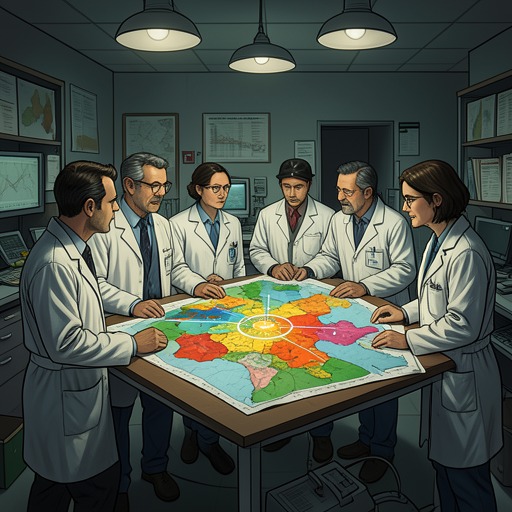
The SARS investigation offers a later illustration of this collective process. In 2003, the World Health Organization coordinated eleven laboratories across countries and regions, which shared virus samples, analyses, and results. Although an electron microscopist at the Centers for Disease Control first spotted the coronavirus, identifying it as the cause of SARS required weeks of work by laboratories that compared evidence and eliminated other candidates. The book describes the result as a collective discovery, not the achievement of one scientist. The episode makes concrete the larger principle associated with open science: the circulation of evidence lets separate researchers contribute to a finding that no one laboratory could establish as quickly alone.
Scrutiny, Trust, and Scientific Acceptance
Open exchange does not mean that scientific conclusions are established by a simple vote or that truth depends on popularity. The coronavirus caused SARS before scientists announced the result. But a claim becomes part of scientific knowledge when other researchers scrutinize the work and accept that it supports the conclusion. Scientific recognition is therefore communal: it helps determine which contributions are incorporated, provisionally, into the common fund of knowledge.
That process also depends on trust. Most scientists do not replicate every experiment on which their work relies; they must often judge evidence produced by others. If a researcher cannot reproduce a well-established result, the first explanation may be a limitation in the attempt, rather than a flaw in the original work. Replication and the exposure of fraud remain essential, but science would stagnate if every researcher spent all available effort retracing previous experiments. The account therefore presents scientific cooperation as working alongside competition: shared knowledge depends both on open communication and on confidence that researchers handle evidence fairly.
Significance
The Royal Society’s founding stands in the article as an institutional precedent for the broader claim that scientific knowledge is collective. Open access gives discoveries a life beyond their originators: other researchers can test, contest, and use them, while the scientific community determines whether a claim earns a place in shared knowledge. The Society’s history thus anchors a vision of science in which progress depends not only on individual insight, but also on durable practices of publication, exchange, scrutiny, and trust.